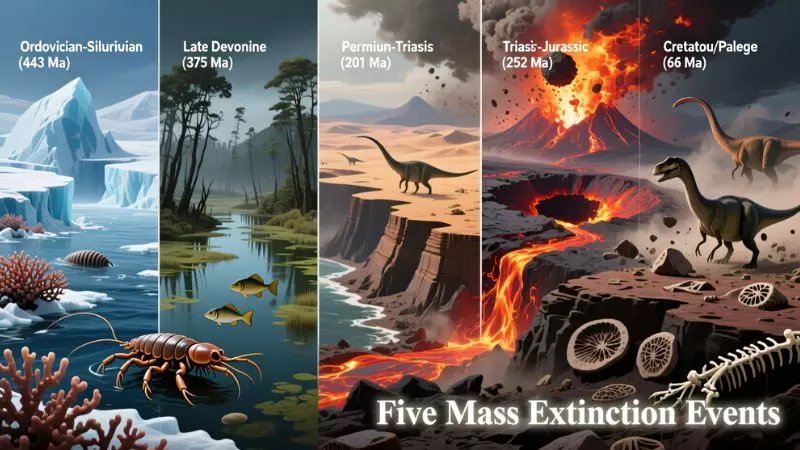
The history of Earth has witnessed several dramatic shifts in life, and 5 Mass Extinction Events stand out as the most significant. These events caused widespread species loss and reshaped ecosystems, making them a crucial part of understanding our planet’s biological history.
Scientists study these mass extinctions to learn about ancient biodiversity, climate changes, and the factors that led to large-scale species extinction. Exploring these events provides insight into how life on Earth has evolved and adapted over millions of years.
5 Mass Extinction Events
Earth’s biological history has been shaped by five major mass extinction events that dramatically altered life on the planet. These events caused extensive species loss and reshaped ecosystems, leaving a lasting impact on the course of evolution. Studying these events provides essential insight into how life responds to environmental stress and ecological change.
Understanding the Big Five extinctions is key to learning about biodiversity loss, ancient ecosystems, and evolutionary patterns. These events highlight how species adapt, survive, or vanish when faced with rapid environmental transformations.
5 Mass Extinction Events Timeline
The following table summarizes the timeline, impact, and main causes of the major mass extinctions:
| Extinction Event | Geological Era | Approximate Time (Million Years Ago) | Estimated Species Lost | Main Cause(s) |
| End‑Ordovician | Paleozoic | ~444 | ~85% marine species | Glaciation, sea level changes |
| Late Devonian | Paleozoic | ~372–359 | ~70–75% species | Ocean anoxia, climate shifts |
| End‑Permian | Paleozoic | ~252 | ~90–96% species | Volcanic activity, global warming |
| End‑Triassic | Mesozoic | ~201 | ~80% species | Volcanism, ecosystem stress |
| Cretaceous‑Paleogene | Mesozoic | ~66 | ~75–80% species | Asteroid impact, climate disruption |
This timeline illustrates how mass extinctions correspond with major geologic periods and reflect abrupt environmental and climatic changes.
What Caused the 5 Mass Extinctions
Each mass extinction had unique causes, often involving multiple environmental stressors:
- End‑Ordovician Extinction: Rapid glaciation and melting ice sheets caused sea level fluctuations, reducing marine habitats and triggering widespread species loss.
- Late Devonian Extinction: Oxygen depletion in oceans (anoxia), climate instability, and ecosystem stress led to a prolonged decline in biodiversity.
- End‑Permian Extinction: Massive volcanic eruptions released greenhouse gases, causing extreme global warming, ocean acidification, and habitat collapse.
- End‑Triassic Extinction: Volcanic activity and climate instability disrupted ecosystems, opening ecological space for dinosaurs.
- Cretaceous‑Paleogene Extinction: An asteroid impact created dust clouds that blocked sunlight, disrupted food chains, and caused massive species die-off, including non-avian dinosaurs.
These causes show that mass extinctions result from complex interactions between climate, geology, and ecological stress.
5 Mass Extinction Events in History
The Big Five extinction events mark turning points in evolutionary history:
- Ordovician‑Silurian Extinction: Early marine biodiversity loss due to sudden climate changes.
- Late Devonian Extinction: Affects reef ecosystems and early fish species.
- Permian‑Triassic Extinction: The deadliest extinction, reshaping global biodiversity.
- Triassic‑Jurassic Extinction: Allowed dinosaurs to dominate the Mesozoic era.
- Cretaceous‑Paleogene Extinction: Ended the reign of non-avian dinosaurs and transformed terrestrial and marine ecosystems.
These events highlight the resilience and adaptability of life over millions of years.
5 Mass Extinction Events 2022

While the historic five extinctions occurred over geologic time, scientists recognize that a sixth extinction is occurring today, driven by human activity. Habitat destruction, climate change, pollution, invasive species, and overexploitation are accelerating species loss far beyond natural background rates.
Modern research emphasizes the urgent need for conservation and environmental protection to prevent biodiversity collapse on a global scale. This highlights how studying past mass extinctions can inform our response to current ecological crises.
5 Mass Extinction Events List
Here is a clear list of the five major mass extinctions:
- End‑Ordovician Extinction – Significant marine life loss due to glaciation and sea level changes.
- Late Devonian Extinction – Prolonged biodiversity decline affecting reef-building organisms and fish.
- End‑Permian Extinction – The deadliest event, reshaping ecosystems worldwide.
- End‑Triassic Extinction – Enabled dinosaurs to dominate terrestrial ecosystems.
- Cretaceous‑Paleogene Extinction – Ended the age of non-avian dinosaurs and many other species.
This list provides a framework for understanding major evolutionary shifts and long-term biodiversity trends on Earth.
Mass Extinction Causes
Mass extinctions are triggered by a combination of natural and environmental factors that overwhelm ecosystems faster than species can adapt. Understanding these causes helps scientists predict how current biodiversity loss may evolve.
Common causes include:
- Climate Change: Rapid global warming or cooling disrupts habitats and food chains.
- Volcanic Activity: Massive eruptions release greenhouse gases, causing ocean acidification and extreme temperatures.
- Asteroid Impacts: Collisions produce dust clouds, block sunlight, and collapse ecosystems.
- Ocean Anoxia: Oxygen depletion in oceans leads to widespread marine species die-off.
- Habitat Loss: Drastic changes in land and sea ecosystems reduce species survival chances.
These causes show that extinction events are usually complex, with multiple factors acting together to drive large-scale species loss.
All Mass Extinction Events
Throughout Earth’s history, several mass extinctions have reshaped life. The five major events are most widely recognized, but smaller events have also significantly impacted biodiversity.
- End‑Ordovician Extinction – Marine species affected due to glaciation.
- Late Devonian Extinction – Reef-building organisms and early fish decline.
- End‑Permian Extinction – The deadliest, eliminating up to 96% of species.
- End‑Triassic Extinction – Dinosaurs rise after ecosystem collapse.
- Cretaceous‑Paleogene Extinction – Dinosaurs (except birds) disappear due to asteroid impact.
- Minor Extinctions: Several smaller events also influenced evolution by eliminating localized species and reshaping ecosystems.
Studying all mass extinctions provides insight into how life adapts to extreme environmental stress.
Mass Extinction Events Timeline
Below is a geologic timeline of the five major mass extinctions:
| Extinction Event | Geological Era | Approx. Time (Million Years Ago) | Estimated Species Lost | Main Cause(s) |
| End‑Ordovician | Paleozoic | ~444 | ~85% marine species | Glaciation, sea level changes |
| Late Devonian | Paleozoic | ~372–359 | ~70–75% species | Ocean anoxia, climate shifts |
| End‑Permian | Paleozoic | ~252 | ~90–96% species | Volcanism, global warming |
| End‑Triassic | Mesozoic | ~201 | ~80% species | Volcanic activity, ecosystem stress |
| Cretaceous‑Paleogene | Mesozoic | ~66 | ~75–80% species | Asteroid impact, climate disruption |
This timeline demonstrates how mass extinctions are tied to geologic periods, climate shifts, and biodiversity loss.
5 Mass Extinction Events on Earth
The five mass extinction events on Earth represent critical turning points in the planet’s biological and evolutionary history:
- End‑Ordovician: Marine species lost due to glacial cycles.
- Late Devonian: Significant reef ecosystem collapse.
- End‑Permian: Extreme volcanic activity causes largest species die-off.
- End‑Triassic: Dinosaurs emerge as dominant terrestrial animals.
- Cretaceous‑Paleogene: Asteroid impact ends the reign of non-avian dinosaurs.
Each event reflects the vulnerability of life to rapid environmental change and highlights the resilience of ecosystems over millions of years.
5 Mass Extinction Events in Order
Understanding the chronological order of the Big Five helps contextualize Earth’s evolutionary history:
- End‑Ordovician Extinction – ~444 million years ago
- Late Devonian Extinction – ~372–359 million years ago
- End‑Permian Extinction – ~252 million years ago
- End‑Triassic Extinction – ~201 million years ago
- Cretaceous‑Paleogene Extinction – ~66 million years ago
Studying these events in order shows how biodiversity loss and recovery shaped the evolution of modern life on Earth.
5 Mass Extinction Events Causes
The 5 Mass Extinction Events were driven by a combination of environmental, geological, and astronomical factors. These causes disrupted ecosystems faster than species could adapt, leading to massive biodiversity loss.
Key causes include:
- Climate Shifts: Rapid warming or cooling events altered habitats and food availability.
- Volcanic Activity: Massive eruptions released greenhouse gases, triggering ocean acidification and temperature spikes.
- Asteroid Impacts: Collisions blocked sunlight, disrupted photosynthesis, and caused widespread extinction.
- Ocean Anoxia: Oxygen depletion in oceans caused extensive marine die-offs.
- Habitat Loss and Environmental Stress: Rapid sea level changes and ecosystem collapses reduced survival chances for many species.
Understanding these causes helps scientists predict potential risks for current biodiversity under climate change and human impact.
5 Mass Extinction Events List
Here is a clear list of the five major mass extinction events in Earth’s history:
- End‑Ordovician Extinction – ~444 million years ago, marine species decline due to glaciation.
- Late Devonian Extinction – ~372–359 million years ago, reef ecosystems and early fishes affected.
- End‑Permian Extinction – ~252 million years ago, largest die-off with ~96% species lost.
- End‑Triassic Extinction – ~201 million years ago, allowed dinosaurs to dominate.
- Cretaceous‑Paleogene Extinction – ~66 million years ago, asteroid impact ends non-avian dinosaurs.
This list highlights the most critical events that reshaped life and allowed new species to emerge.
5 Mass Extinction Events Explained
Each of the 5 Mass Extinction Events had unique characteristics, yet all reshaped life on Earth:
- End‑Ordovician: Triggered by glacial cycles, causing major marine biodiversity loss.
- Late Devonian: A prolonged extinction linked to ocean anoxia and climate stress.
- End‑Permian: The deadliest extinction, driven by volcanic activity, global warming, and ocean acidification.
- End‑Triassic: Disrupted ecosystems, paving the way for dinosaur domination.
- Cretaceous‑Paleogene: Asteroid impact created catastrophic environmental changes, eliminating many species including non-avian dinosaurs.
Studying these events helps us understand how life adapts or collapses under extreme environmental changes.
5 Mass Extinction Events Documentary
Documentaries on the 5 Mass Extinction Events visually illustrate Earth’s past ecological crises and species recovery. They explore:
- The scale of biodiversity loss during each extinction.
- The geological and climatic causes behind each event.
- How mass extinctions reshaped evolution and allowed new species to thrive.
- Modern parallels with ongoing biodiversity loss and human-driven environmental change.
Watching documentaries can provide a clear timeline of events, showing both the devastation and the resilience of life over millions of years.
All 5 Mass Extinction Events
The Big Five Mass Extinction Events together highlight key moments in evolutionary history:
| Extinction Event | Approx. Time (Million Years Ago) | Estimated Species Lost | Key Cause |
| End‑Ordovician | ~444 | ~85% | Glaciation, sea level changes |
| Late Devonian | ~372–359 | ~70–75% | Ocean anoxia, climate shifts |
| End‑Permian | ~252 | ~90–96% | Volcanism, global warming |
| End‑Triassic | ~201 | ~80% | Volcanic activity, ecosystem stress |
| Cretaceous‑Paleogene | ~66 | ~75–80% | Asteroid impact, climate disruption |
These events illustrate how Earth’s life has evolved through catastrophic changes, providing context for understanding modern environmental challenges.
What Caused the 5 Mass Extinction Events
The 5 Mass Extinction Events were caused by a combination of environmental, geological, and astronomical factors. These triggers disrupted ecosystems faster than species could adapt, resulting in massive biodiversity loss.
Key causes include:
- Climate Change: Rapid global warming or cooling altered habitats and food chains.
- Volcanic Eruptions: Large-scale volcanism released greenhouse gases, causing ocean acidification and temperature extremes.
- Asteroid Impacts: Collisions blocked sunlight, disrupted photosynthesis, and led to widespread extinction.
- Ocean Anoxia: Oxygen-depleted oceans caused large-scale marine species die-offs.
- Habitat Collapse: Rapid changes in sea levels and ecosystems reduced survival opportunities.
Understanding these causes provides insight into how life on Earth responds to environmental crises.
There Have Been 5 Mass Extinction Events
Throughout Earth’s history, there have been five major mass extinction events that reshaped life. Each event resulted in large-scale species loss and opened ecological niches for new groups to emerge.
- End‑Ordovician Extinction: ~444 million years ago, marine life was heavily impacted by glaciation.
- Late Devonian Extinction: ~372–359 million years ago, reef ecosystems and early fish species suffered.
- End‑Permian Extinction: ~252 million years ago, the deadliest event with up to 96% of species lost.
- End‑Triassic Extinction: ~201 million years ago, allowed dinosaurs to dominate terrestrial ecosystems.
- Cretaceous‑Paleogene Extinction: ~66 million years ago, asteroid impact eliminated non-avian dinosaurs.
These events are milestones in Earth’s evolutionary history and demonstrate the vulnerability and resilience of life.
Big 5 Mass Extinction Events
The Big Five mass extinction events are the most significant extinction events in Earth’s history. They drastically reduced biodiversity and shaped the course of evolution:
- End‑Ordovician Extinction: Marine species heavily affected by glacial cycles.
- Late Devonian Extinction: Long-term decline of reef ecosystems and early fish species.
- End‑Permian Extinction: Largest species die-off, altering global ecosystems.
- End‑Triassic Extinction: Opened ecological space for dinosaur dominance.
- Cretaceous‑Paleogene Extinction: Ended the era of non-avian dinosaurs and many other species.
These events highlight how environmental and geological stressors have repeatedly reshaped life on Earth.
Top 5 Mass Extinction Events
The top five mass extinction events by severity and impact on global biodiversity are:
- End‑Ordovician Extinction – ~85% species lost due to glaciation.
- Late Devonian Extinction – ~70–75% species lost due to ocean anoxia.
- End‑Permian Extinction – ~90–96% species lost, the deadliest event.
- End‑Triassic Extinction – ~80% species lost, allowed dinosaurs to flourish.
- Cretaceous‑Paleogene Extinction – ~75–80% species lost from asteroid impact.
This ranking shows the magnitude of biodiversity loss and its long-term effects on evolution.
3 of 5 Mass Extinction Events Occurred During Which Era
Three of the Big Five mass extinction events occurred during the Paleozoic Era:
- End‑Ordovician Extinction – ~444 million years ago
- Late Devonian Extinction – ~372–359 million years ago
- End‑Permian Extinction – ~252 million years ago
The remaining two occurred during the Mesozoic Era:
- End‑Triassic Extinction – ~201 million years ago
- Cretaceous‑Paleogene Extinction – ~66 million years ago
Understanding the era in which these events occurred helps contextualize their impact on the evolution of life and the transition between geological periods.
What Are the 5 Mass Extinction Events and What Caused Them
The 5 Mass Extinction Events represent the most significant episodes of species loss in Earth’s history. They reshaped biodiversity and ecosystems, paving the way for new species to evolve.
Major causes of these events include:
- Climate Change: Rapid global warming or cooling disrupted habitats.
- Volcanic Activity: Eruptions released massive greenhouse gases, acidifying oceans and raising global temperatures.
- Asteroid Impacts: Large collisions blocked sunlight, disrupted photosynthesis, and led to widespread extinction.
- Ocean Anoxia: Oxygen depletion in oceans caused massive marine die-offs.
- Habitat Collapse: Sea level changes and environmental stress destroyed ecosystems.
These events illustrate how life responds to extreme environmental change and how biodiversity can recover over time.
What Was the First of the Big 5 Mass Extinction Events
The first of the Big Five mass extinction events was the End‑Ordovician Extinction, occurring approximately 444 million years ago. This event primarily affected marine life, as glaciation and rapid sea level fluctuations eliminated shallow-water habitats. Around 85% of marine species were lost during this period, including many trilobites, brachiopods, and reef-building organisms.
The End‑Ordovician Extinction set a precedent for understanding how sudden climate shifts can trigger global biodiversity loss.
What Were the Causes of the Previous 5 Mass Extinction Events on Earth
The five major mass extinctions each had unique causes, though many share overlapping environmental stressors:
- End‑Ordovician: Glacial cycles and sea level drops reduced marine habitats.
- Late Devonian: Ocean anoxia and climate instability caused prolonged biodiversity decline.
- End‑Permian: Massive volcanic eruptions released greenhouse gases, leading to global warming and ocean acidification.
- End‑Triassic: Volcanic activity and climate stress disrupted ecosystems, allowing dinosaurs to thrive.
- Cretaceous‑Paleogene: Asteroid impact caused dust clouds, blocked sunlight, and collapsed food chains.
These causes reveal that mass extinctions are generally triggered by complex interactions between geological, climatic, and astronomical events.
What Happened on Each of the 5 Mass Extinction Events
Here’s a concise overview of what occurred during each event:
- End‑Ordovician: ~85% of marine species died due to glaciation and habitat loss.
- Late Devonian: Reef ecosystems collapsed and early fish species declined over millions of years.
- End‑Permian: ~90–96% of species vanished; the event is known as “The Great Dying.”
- End‑Triassic: ~80% species were lost; dinosaurs emerged as dominant land animals.
- Cretaceous‑Paleogene: ~75–80% species, including non-avian dinosaurs, were wiped out by an asteroid impact.
Each event represents a critical turning point in the evolution and recovery of life on Earth.
5 Major Mass Extinction Events
Below is a summary table of the 5 major mass extinction events, their timing, and causes:
| Extinction Event | Time (Million Years Ago) | Estimated Species Lost | Main Causes |
| End‑Ordovician | ~444 | ~85% | Glaciation, sea level changes |
| Late Devonian | ~372–359 | ~70–75% | Ocean anoxia, climate shifts |
| End‑Permian | ~252 | ~90–96% | Volcanism, global warming |
| End‑Triassic | ~201 | ~80% | Volcanic activity, ecosystem stress |
| Cretaceous‑Paleogene | ~66 | ~75–80% | Asteroid impact, climate disruption |
This table illustrates the scale and causes of the five major mass extinctions, providing context for understanding Earth’s evolutionary history and biodiversity patterns.
5 Great Mass Extinction Events
The 5 great mass extinction events represent the most catastrophic episodes in Earth’s history where a huge number of species vanished in a relatively short period. These events dramatically reshaped ecosystems and opened niches for new life forms to evolve.
Key aspects of these great extinctions include:
- Rapid environmental change that many species could not adapt to.
- Significant impact on both marine and terrestrial ecosystems.
- Reshaping of evolutionary trajectories and biodiversity patterns.
Studying these events helps scientists understand the resilience and vulnerability of life under extreme conditions.
5 Main Mass Extinction Events
The 5 main mass extinction events are widely recognized as the critical turning points in Earth’s evolutionary history:
- End‑Ordovician Extinction – ~444 million years ago; ~85% of marine species lost due to glaciation.
- Late Devonian Extinction – ~372–359 million years ago; ~70–75% species lost from ocean anoxia.
- End‑Permian Extinction – ~252 million years ago; ~90–96% species lost, the deadliest extinction.
- End‑Triassic Extinction – ~201 million years ago; ~80% species lost, dinosaurs emerged.
- Cretaceous‑Paleogene Extinction – ~66 million years ago; ~75–80% species lost, asteroid impact caused collapse.
These main events illustrate the scale and severity of past biodiversity crises.
5 Previous Mass Extinction Events
The 5 previous mass extinction events occurred before the rise of modern species and profoundly influenced life on Earth:
- End‑Ordovician: Marine life heavily impacted by glaciation and sea level changes.
- Late Devonian: Reef ecosystems and early fishes declined over millions of years.
- End‑Permian: Extreme volcanic activity caused the largest die-off in history.
- End‑Triassic: Ecosystem collapse allowed dinosaurs to dominate.
- Cretaceous‑Paleogene: Asteroid impact eliminated non-avian dinosaurs and many other species.
These events are critical for understanding how life evolves and recovers after catastrophic environmental stress.
5 Global Mass Extinction Events
The 5 global mass extinction events affected life on a planetary scale, not just in localized regions, resulting in massive biodiversity loss:
| Extinction Event | Approx. Time (Million Years Ago) | Estimated Species Lost | Main Cause |
| End‑Ordovician | ~444 | ~85% | Glaciation, sea level changes |
| Late Devonian | ~372–359 | ~70–75% | Ocean anoxia, climate shifts |
| End‑Permian | ~252 | ~90–96% | Volcanism, global warming |
| End‑Triassic | ~201 | ~80% | Volcanic activity, ecosystem stress |
| Cretaceous‑Paleogene | ~66 | ~75–80% | Asteroid impact, climate disruption |
These global events demonstrate the power of environmental and geological factors to reshape life on Earth and highlight the resilience of surviving species.
Frequently Asked Questions
What are the 5 Mass Extinction Events?
The 5 Mass Extinction Events are the largest biodiversity crises in Earth’s history, each causing massive species loss and reshaping ecosystems.
When did the 5 Mass Extinction Events occur?
They occurred at different geological periods: Ordovician (~444 Mya), Devonian (~372–359 Mya), Permian (~252 Mya), Triassic (~201 Mya), Cretaceous-Paleogene (~66 Mya).
What caused the 5 Mass Extinction Events?
Causes include rapid climate change, volcanic eruptions, asteroid impacts, ocean anoxia, and massive habitat loss.
How many species were lost in the 5 Mass Extinction Events?
Loss ranged from 70% to over 90% of species, with the End-Permian extinction being the deadliest.
Which era did most of the 5 Mass Extinction Events happen in?
Three of the five occurred during the Paleozoic Era, while the remaining two took place in the Mesozoic Era.
What was the first of the 5 Mass Extinction Events?
The first was the End-Ordovician extinction around 444 million years ago, primarily affecting marine species.
How did the 5 Mass Extinction Events shape evolution?
They eliminated dominant species, allowing new organisms to emerge and diversify, shaping the course of life on Earth.
Are we experiencing a 6th mass extinction like the 5 Mass Extinction Events?
Many scientists believe human-driven biodiversity loss may represent a sixth mass extinction due to habitat destruction and climate change.
Conclusion
The 5 Mass Extinction Events mark the most dramatic periods of species loss in Earth’s history. Each event caused significant ecological disruption and reshaped life on the planet.
Studying the 5 Mass Extinction Events helps us understand how environmental changes, climate shifts, and catastrophic events impact biodiversity, providing lessons for preserving life today.

Emma Collins is the creative mind behind PunsStory.com, a unique corner of the internet where laughter, wit, and clever wordplay come alive. With a passion for humor and storytelling, Emma brings together the best collection of Funny Puns 😂, Love Puns ❤️, Animal Puns 🐶🐱, Food Puns 🍕☕, and Meme Puns 🔥 to brighten your day.
Her writing style is simple yet smart, making puns fun for readers of all ages. Whether it’s a quick giggle, a lighthearted moment, or a clever twist of words, Emma believes that humor is the best way to connect with people.
Through PunsStory.com, she aims to spread positivity, spark creativity, and remind everyone that even the smallest pun can bring the biggest smile.